Issue #237: Sesame Walnuts
A Chinese Technique Produces Seamingly Simple Nuts

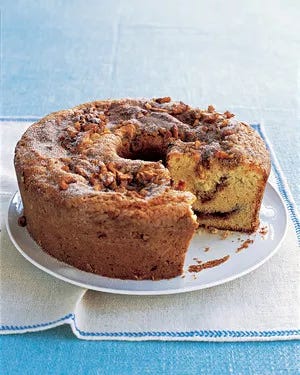
Walnuts are the Zelig of tree nuts. They are commonly known as English walnuts, so it’s no surprise they are popular in the U.K. When you are traveling in southwest France, it’s easy to think of them as uniquely associated with the Dordogne. Liguria has its walnut pesto, Emilia-Romagna its nocino. Mittleurope has any number of walnut specialties, savor and sweet. Where would Lebanese baklava be without them? And then there’s my mother’s kitchen, where walnuts were a common addition to baked goods, such as brownies, cookies, and coffee cake. (She’d sneak handfuls to make sure they were fresh.)
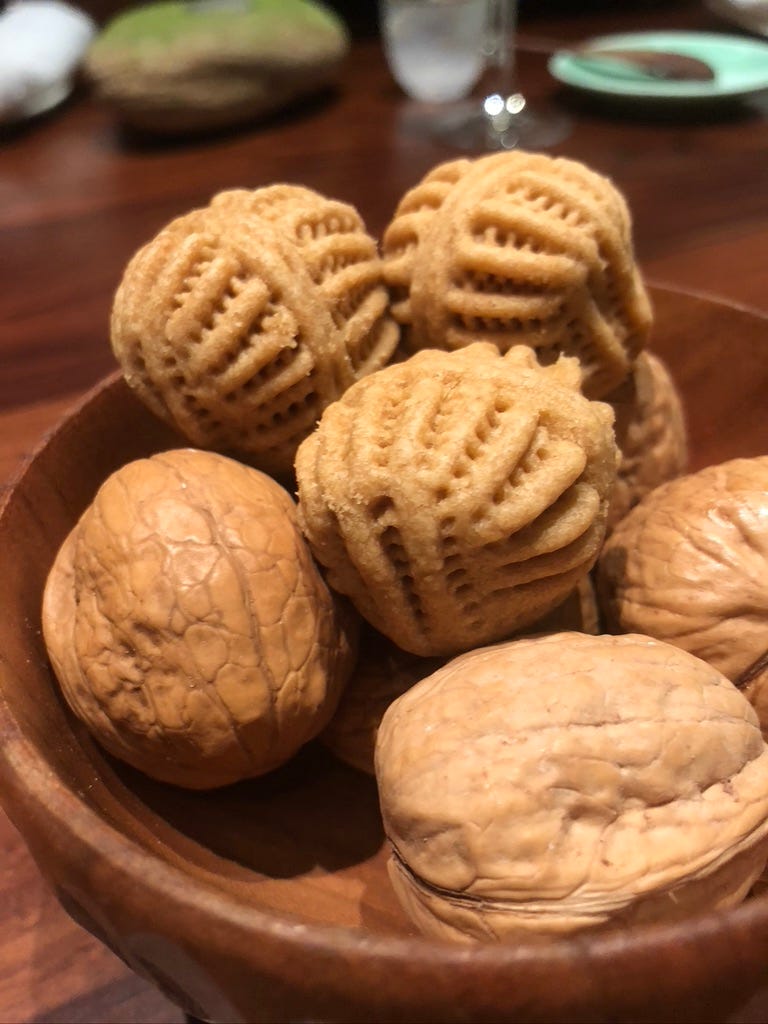
That said, you might not immediately associate walnuts with Chinese food. And yet, among the most delicious and beguiling walnuts I’ve ever eaten were served as a sort of mignardise at a fine restaurant in Shanghai. After an exquisite meal in a private dining room at Fu He Hui, a bowl of warm walnut cookies and walnuts in the shell arrived. To our surprise when we cracked open the shells, the nuts had been infused with a rich, buttery vanilla flavor. While we westerners puzzled over how they managed to get that flavor inside, the Chinese we were with waxed nostalgic for this childhood treat. Go figure.
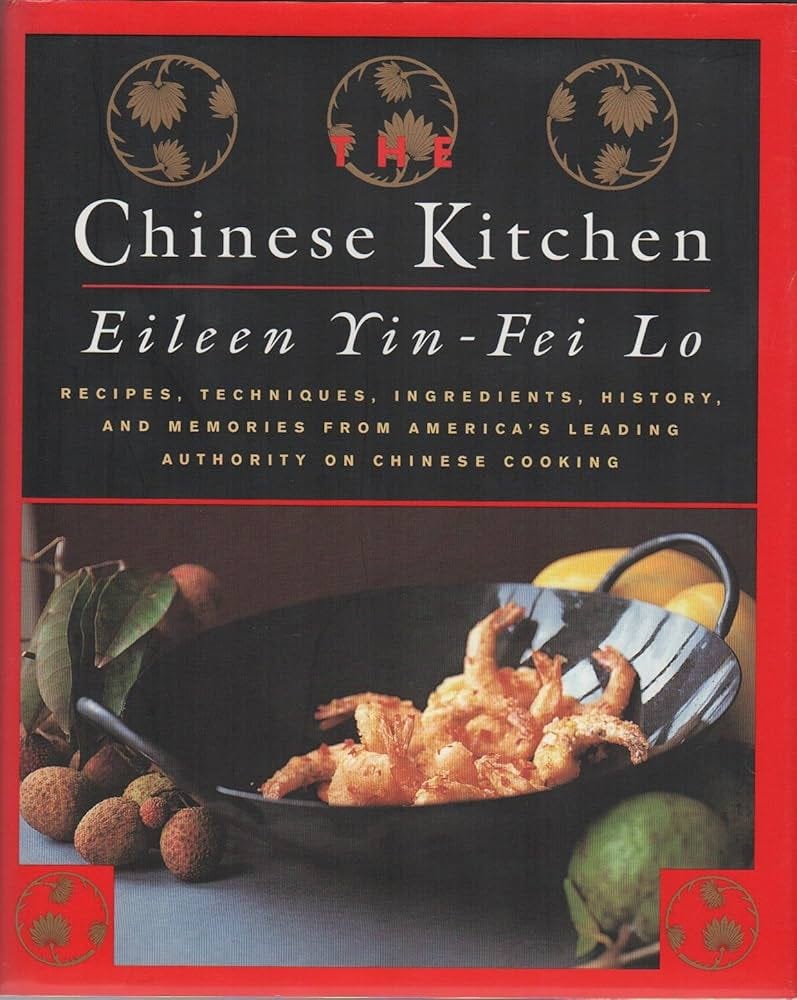
I shouldn’t have been surprised to find walnuts in China. For some 25 years I’ve been making a Chinese walnut snack at home, thanks to a recipe I found in a favorite cookbook by the late Eileen Yin-Fei Lo called The Chinese Kitchen. Although perhaps not as well-known now as the current British Chinese food authority Fuchsia Dunlop, Yin-Fei Lo was at it long before and her influence among Chinese chefs, restaurateurs, and home cooks in America was profound. While Dunlop’s knowledge is rooted in her time spent studying in Sichuan province, Yin-Fei Lo drew on her Cantonese upbringing. She was passionate about authentic Chinese cooking and along with her late husband, food writer, and restaurant reviewer Fred Ferretti, who wrote for the New York Times and Gourmet, they were a power couple for decades.
Every recipe of Yin-Fei Lo’s I’ve ever use not only worked, but also tasted like the dish I had in my mind. Perhaps that’s because we lived in the same town, shopped in the same Asian grocery stores, and ate in the same Chinese restaurants. Our paths often crossed at the same events. Regardless, she wrote recipes for food I still want to eat.
Eileen’s Nuts
The holidays are approaching and for some reason, perhaps their expense, people associate nuts with this festive time of year. I love a good spiced nut, but if I’m being totally honest, I’ve never found a recipe for them that made anything as good as I imagined it would be. I’ve tried many, including some favorites of favorite chefs who’ve shared recipes with magazines. Meh.
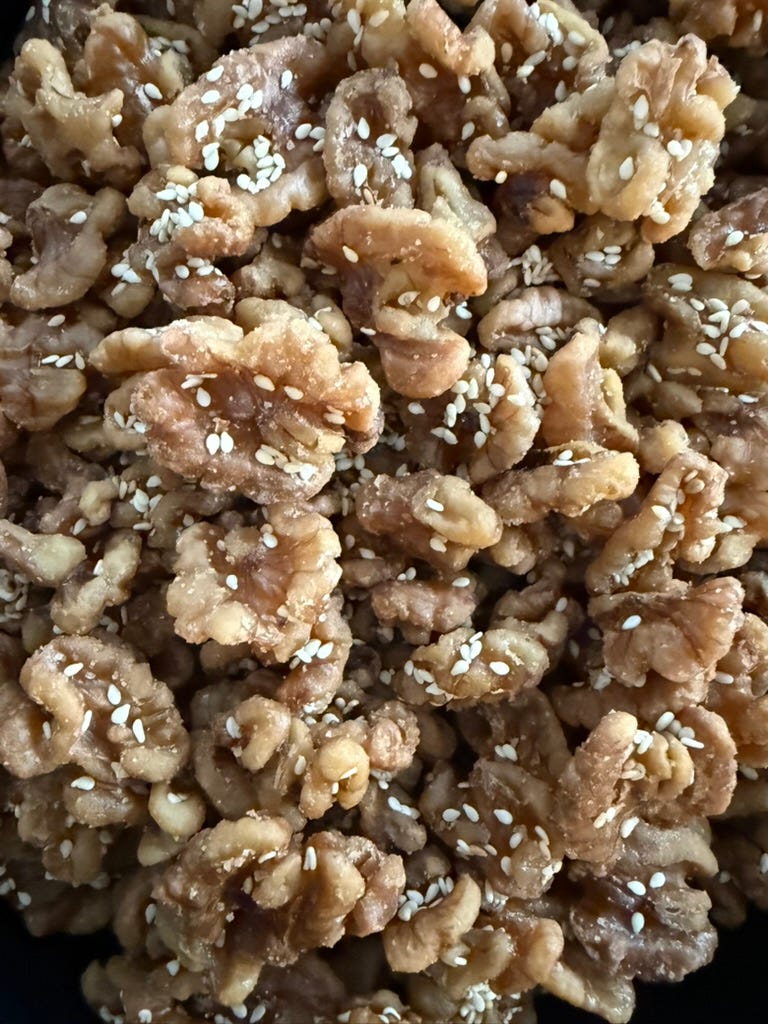
Yin-Fei Lo’s walnuts are different. While not spiced, per se, they are in fact improved by the process you put them through, which results in a crunchy, sweet, and nutty nut that’s better than where it began. Nate says often that the secret to happiness is low expectations. I had none the first time I gave these nuts a try. They kind of blew my mind.
Having cooked many satisfying dishes out of The Chinese Kitchen, I remember first seeing this recipe and thinking it was too much work for a snack. You had to boil the nuts a couple of times, toss them in a sugar syrup, and then deep fry them! A waste of time and oil, I thought.
But something propelled me to give it a try, perhaps the sense that the technique seemed unusual, and thus, perhaps particularly, authentically Chinese. Other recipes for flavored nuts I had made would say things like “simply toast and toss.” Too simple, I guess, for the seasonings usually just fell to the bottom of the bowl. I was intrigued by Yin-Fei Lo’s advice to boil the nuts not once, but twice, to remove bitterness, and by the order of glazing with sugar and then deep frying, which seemed counterintuitive. Trusting her, I made the walnuts as she said. And I’ve been making them ever since, one time in a batch so large for a Chinese banquet I was cooking for the Taoist Tai Chi Society that my kitchen smelled of walnuts for days.
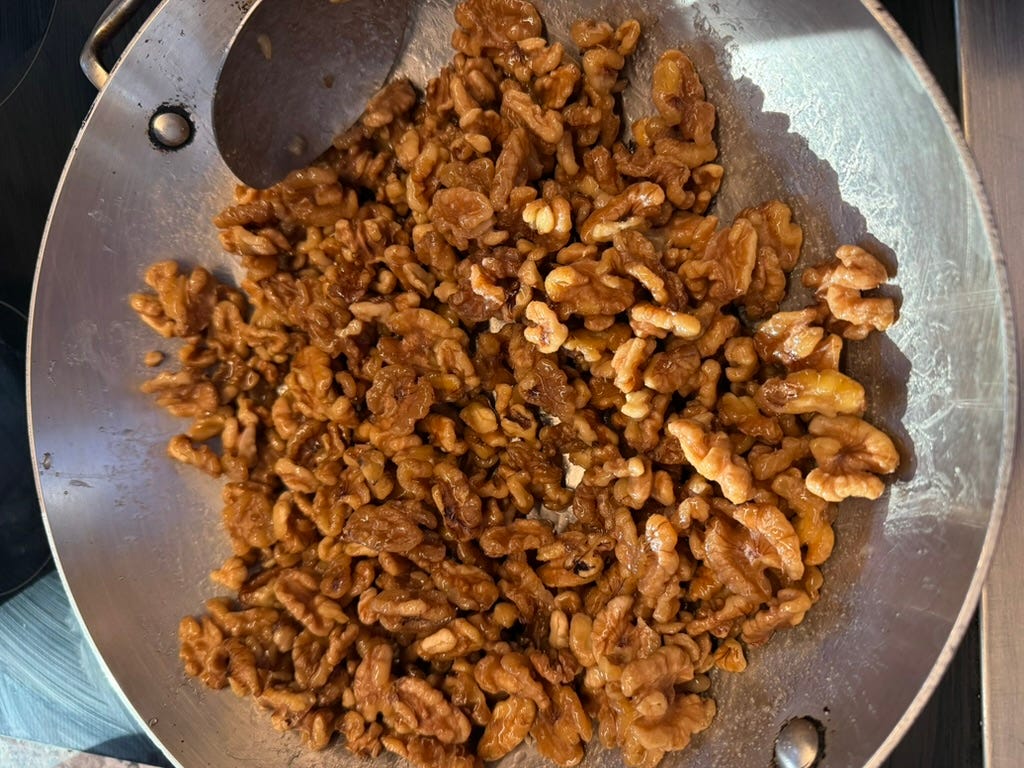
Like most tasks that seem daunting at first, after you make these nuts once, you realize they are pretty straightforward. Like most Yin-Fei Lo recipes, the instructions are detailed and precise. What’s more, the recipe makes a pound of nuts, which is a substantial amount for the effort. They keep for weeks, if you keep your grubby hands out of them.
Freshness Counts
The only caveat I’ll say is you should purchase your walnuts and sesame seeds somewhere you know they are fresh. The flavor of your nuts and seeds will make all the difference in the outcome. And yes, I know some of you are thinking, I couldn’t tell the difference between a good sesame seed and a bad one. But I know you could. I’ve seen otherwise mindless eaters note the intense flavor of good sesame seeds on a challah or Japanese salad.
I skip a step sometimes and use toasted sesame seeds from either Japan or Korea—which are readily available in Asian stores here and online. They come in small, sealed packs I store in the freezer, and the flavor of them is pronounced. Though I’m not generally a fan of Trader Joe’s products, I know they move a lot of nuts. And the walnuts I’ve had from them are always fresh, never rancid. (Though fresh, their almonds, on the other hand, are pretty tasteless; I prefer Costco’s.) With an inferior nut or seed, the effort in making these is wasted. Nuts to that.
If you have a deep fryer, it works great for the final step. Simply transfer the glazed nuts to the basket and lower into fresh, hot oil as directed. If you don’t have one, it helps to have a Chinese strainer, called a spider, so you can lower the glazed nuts into the hot oil for their final bath. It goes without saying that a wok is the cooking vessel of choice, but a wide, deep saucepan or sauté pan will do.
RECIPE: Sesame Walnuts
Makes 1 pound
1/4 cup white sesame seeds, raw or toasted
12 1/4 cups water
1 pound fresh walnut halves
1/3 cup sugar
5 cups peanut oil, for frying
If using raw sesame seeds, you have to toast them first. Heat a wok over high heat for 30 seconds (a saucepan or sauté pan will require additional time to heat up). Lower the heat to medium, add the sesame seeds, and toss using a large spoon or spatula for 2 minutes or so until they begin to brown and give off a nice, nutty aroma. Keep the seeds moving so they toast evenly. Remove to a small bowl and set aside. If using toasted sesame seeds, nothing is required.
In the same pan, bring 6 cups of the water to a boil. Add the walnuts, bring back up to an boil, and let simmer for 5 minutes. This will help remove any bitterness. Drain in a colander, rinse with cold water, and drain well again. Bring another 6 cups of water to a boil. Add back the nuts, and repeat, simmering for 5 minutes. Drain, rinse, and drain again. Rinse and wipe out the wok or saucepan.
Bring the remaining 1/4 cup water to a boil. Add the sugar, stir, and let cook for 1 minute so the sugar dissolves. Add the drained walnuts and stir, tossing, to evenly coat with the syrup. Keep cooking a minute or two, stirring constantly, until the nuts are glazed and any liquid has evaporated. Remove to the basket of a fryer or a Chinese strainer (aka spider).
If using a deep fryer, bring clean oil up to 360°F. If using a wok or pan, rinse and wipe it again to remove any sugar residue. Add the peanut oil and heat to about 360°F. A wisp of white smoke should rise from the surface when ready. Lower the basket or strainer with the glazed nuts into the hot oil and let fry for a minute or so. Remove the strainer and continue frying another 3 minutes or so, breaking the nuts up if they clump, until nicely browned. When done, lift out the nuts and drain well.
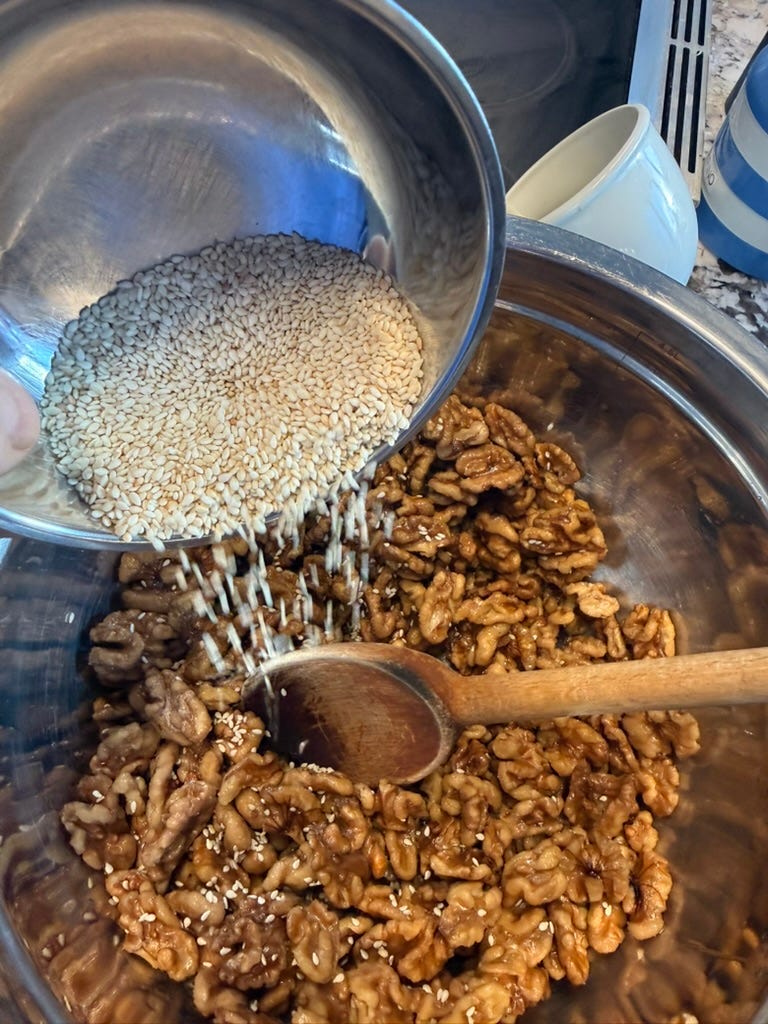
Transfer the fried nuts to a clean bowl. Sprinkle with the toasted sesame seeds while tossing with a wooden spoon to evenly coat. Most of the seeds will stick. Let cool completely and transfer to an airtight container. The nuts will keep at room temperature for a week or frozen for up to 3 months. But they won’t last that long.
Editor’s Note: I’ll be using these nuts as a garnish for a salad of persimmon, pomegranate, chicories, sumac, and preserved lemon at my pop-up dinner tomorrow, Thursday, December 18, 2025, at Wolf Tree in White River Junction. Please come by and give them a try.
"Every recipe of Yin-Fei Lo’s I’ve ever use not only worked, but also tasted like the dish I had in my mind." There is truly no higher compliment a recipe developer can receive. You've convinced me to check out her work - excited!