Issue #259: Home Fries
Chewing the Fat with My Sister, So To Speak, Steakhouse Potaotes

Nate and I just spent the weekend with my sister Leslie and her girlfriend Judi. They drove down from Toronto for Canada’s Victoria Day weekend.
As is our family’s custom, we do a lot of sitting around together—also a lot of eating, which means I do a lot of cooking.
A few times while we were kibbitzing in the kitchen, Leslie noted that I cook with more fat than she does. She concentrates on protein.
I’ve never thought about my cooking that way. If anything, I feel I use a lot less fat than most of the chefs I know who cook in restaurants. I’m certain of this from having watched them cook in their kitchens, and also because when I eat most of my meals out, I gain weight.
Aside: professional cooks often chuckle at the expense of the diner who orders the fish because she wants something light, without realizing it has been poached in butter, reheated in butter, and served on a pool of sauce enriched with still more butter.
This got me thinking about fat. You often hear chefs (and butchers) say “fat is flavor,” and I don’t disagree. But of course, vegetables and spices and condiments and quality ingredients and proper cooking techniques are flavor, too.
As I’ve written in this newsletter before, the quality of fat you use is important, not just for flavor, but also for health. I’m not going to get into the complicated and sometimes controversial science of nutrition that explains why one type of fat may be better or worse for you than another. But I will get into what I’ll call the nutrition of gastronomy, that is, how the fats you reach for can maximize both flavor and health.
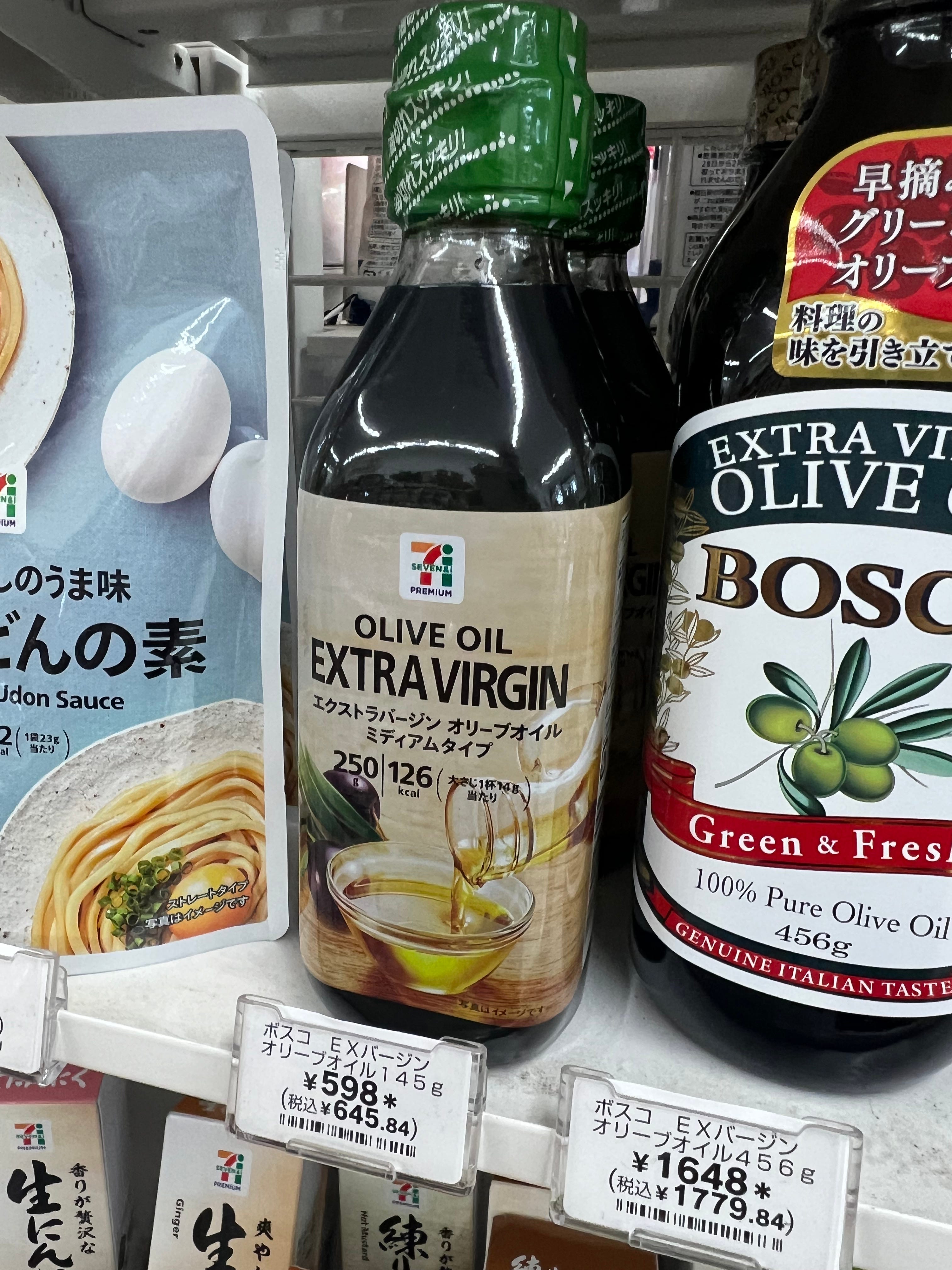
First, a caveat. Good fat is expensive. The best extra-virgin olive oil, which may be one of the best fats for you and for your cooking, is not and should not be cheap. It isn’t expensive just because it’s often imported. It’s relatively expensive in Italy and Spain and Greece and all the other Mediterranean countries where it is the primary fat, too. It’s expensive because it is made in a traditional way, by harvesting olives and pressing them mechanically, and is almost completely unrefined. This is why it is healthful. In fact, as a rule, the cheaper the oil, the less good for you it likely is.
Good extra-virgin olive oil is also perishable. It should come in a dark glass bottle or can that blocks light with an expiration date printed somewhere on it that should be at least one and preferably two years in the future. By law, extra-virgin olive oil in the E.U. has a two-year shelf life, during which period its flavor and health qualities diminish.
I’ll let you in on a little secret. I often buy excellent, new-harvest, extra-virgin olive oil from Spain or Greece at HomeGoods—yes, the same store that sells lawn ornaments shaped like frogs and his-and-hers Valentine’s Day hand towels. They obviously get shipments of new oils from somewhere on a pretty regular basis. The bottles usually have two years to go before expiring and the prices are half what you would pay elsewhere. I snatch them all up when I see them.
Second, a myth to break. Extra-virgin olive oil is perfectly fine for frying, excellent in fact. Few things you should be cooking at home require you to fry at a temperature that would be beyond the smoking point of EVOO. And despite some very famous chefs who have led folks to believe otherwise, I can personally vouch that in Tuscany, where olive oil is king, many cooks use nothing else—if they can afford it. Price is a factor here more than the qualities of the oil.
Next to my olive oil, I keep a virgin peanut oil (that is, unrefined). I like its buttery texture and delicate flavor when a recipe needs something more neutral (and less expensive) than olive oil. I use peanut oil for most of my Asian cooking. In my deep fryer I’ve got organic rice bran oil, which I buy in bulk. I like it for its neutral flavor and high smoke point. I find it makes fried foods light and crisp. I use virgin coconut oil sparingly because I think it imparts a perceptible coconut flavor to things. It’s great for curries, soups and stews that have other coconut components. Nate likes it for popcorn.
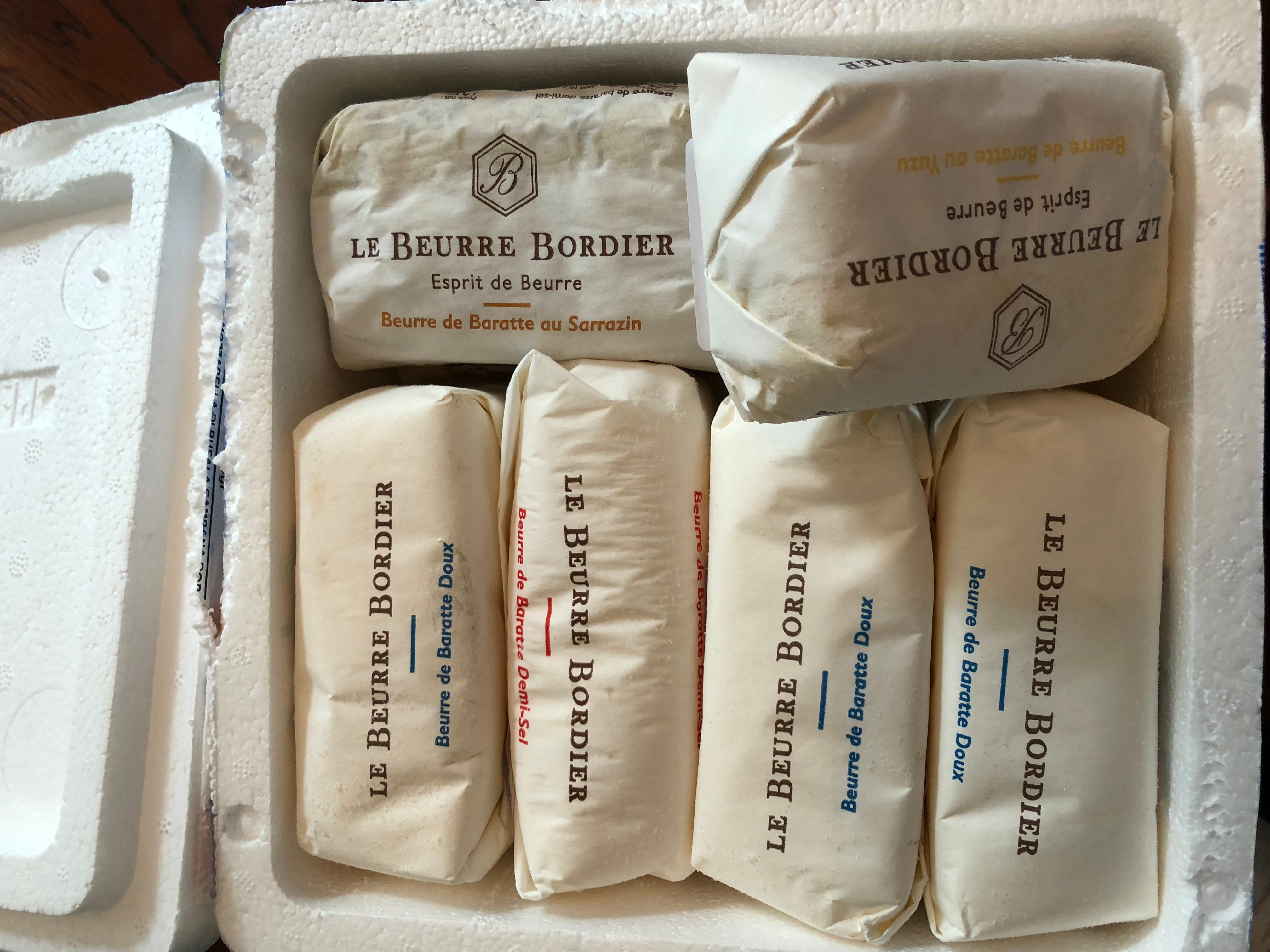
I don’t shy away from animal fats, either. On my counter there’s usually cultured butter made from grass-fed cows. I save the rendered fat from my homemade bacon and I have jars of fat rendered from duck and chicken (“schmaltz”) in the freezer at all times. If you buy good, pasture raised, grass-fed meats, the fats that render from them are excellent to use for cooking, too.
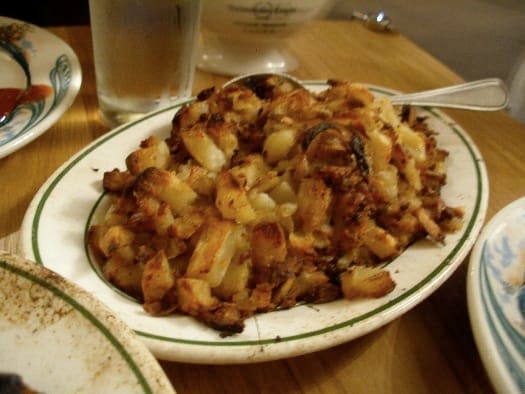
My sister commented on how much fat I use while I was making some home fries to go with steak for dinner. When Leslie is visiting, I take requests. She has some serious food allergies and aversions that make it difficult to eat out. Though she is an excellent cook herself, eating at our place feels to her like she is dining in a series different restaurants. This weekend I made Korean food, Mexican food, and Indian food. Friday was steak night. She specifically requested a few different fried foods throughout the weekend—come to think of it, maybe that’s why she thinks I cook with so much fat—among them, home fries to accompany our steak.
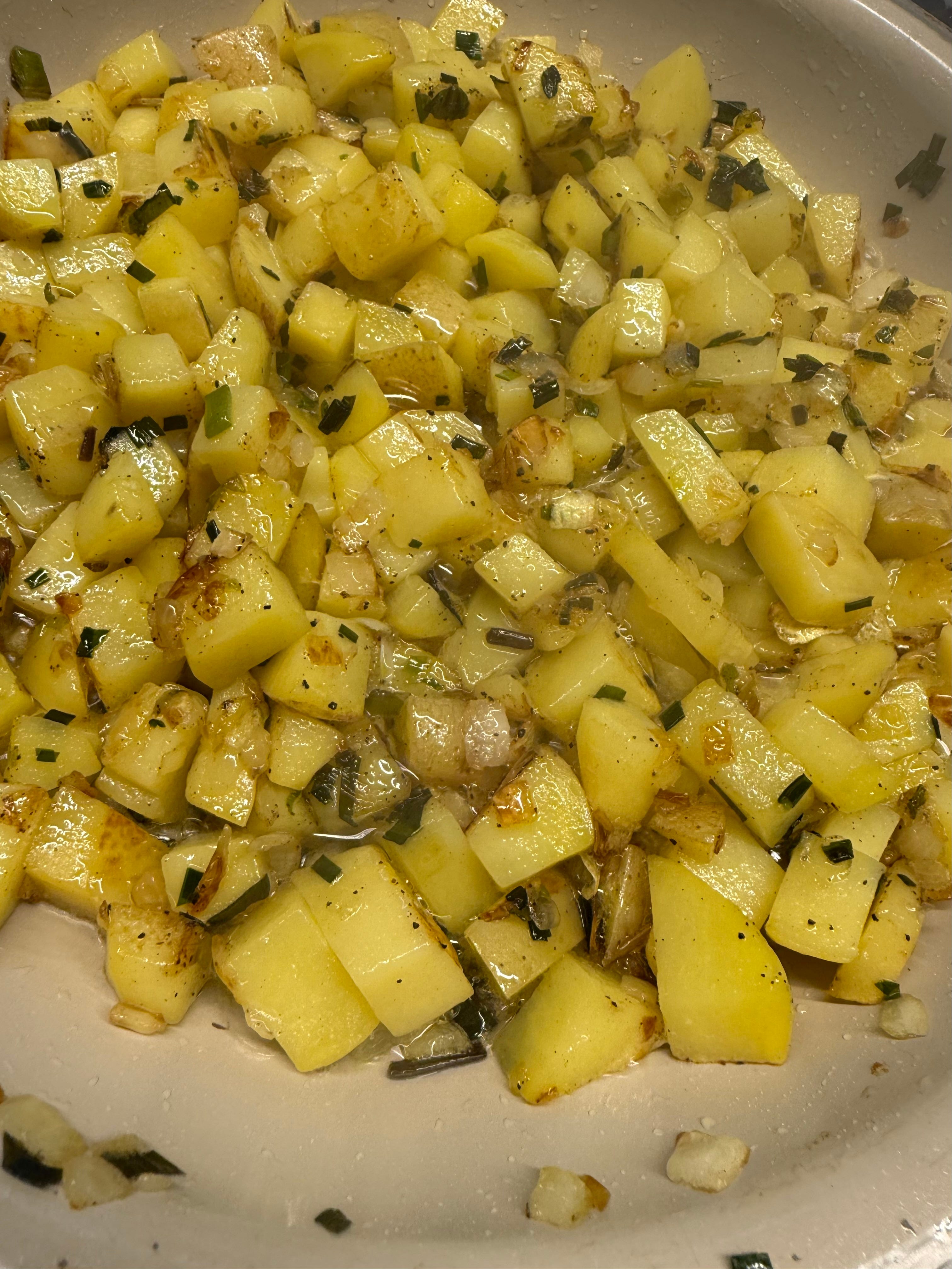
To make these classic steakhouse potatoes—the epitome of which, in my mind, are the German fried potatoes served at Peter Luger’s—I sautéed a generous amount of diced onion and because it is spring, some green garlic and ramps, in a combination of extra-virgin olive oil and the fat that rendered from some duck confit we had for lunch. (I could have used butter, bacon fat, or additional olive oil, too.) When the alliums were soft, I added cubed potatoes, half peeled, half unpeeled, just for textural variety, and plenty of salt, and let them fry in the fat with the onions until soft. I seasoned them with a sprinkle of paprika and some black pepper, and then I let them sit over medium-high heat to brown. I kept breaking them up and letting them brown until they were evenly dark and flavorful.
Home fries are a simple sidedish, as apporpriate at breakfast as at dinner, a nice change from baked or mashed. They just require a little patience, as the potatoes take some time to cook, and more salt than you would think.
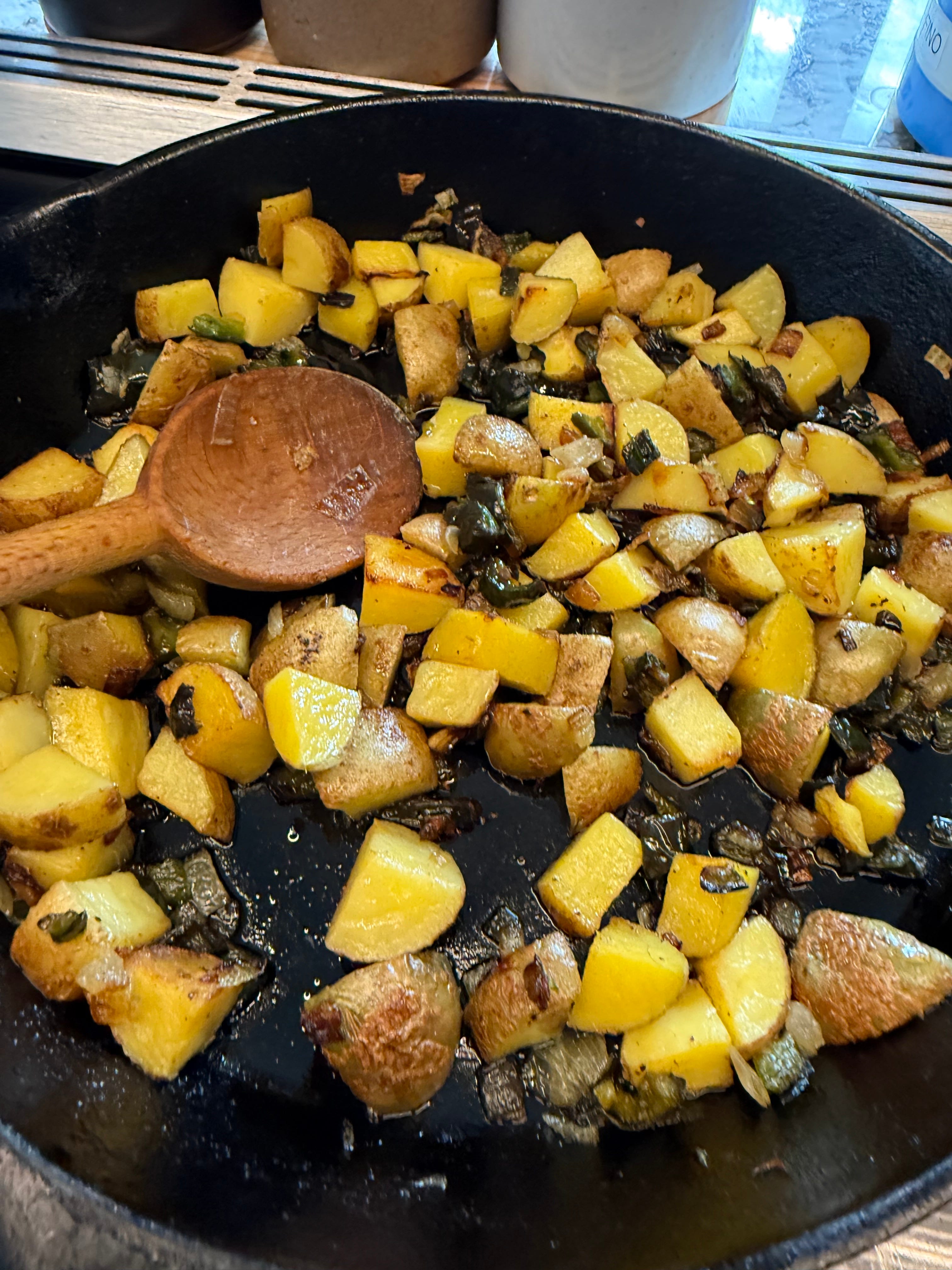
Recipe: Home Fries
4 or 5 tablespoons fat, such as extra-virgin olive oil, butter, rendered bacon or duck fat, or a combination
1 large onion, diced
Sea salt
2 ramps or scallions, chopped (optional)
1 green garlic, chopped (optional)
2 1/2 pounds golden potatoes, half peeled, half not, diced
Paprika
Freshly ground black pepper
In a large cast-iron or heavy-bottom pan, heat the fat over medium-high flame. Add the onion and a pinch of salt and sauté for 3 or 4 minutes until soft. Add the ramps and green garlic, if using, sauté another couple of minutes, until wilted.
Add the cubed potatoes and a generous pinch of salt and stir to coat with the fat. Lower the heat to medium and continue cooking for 10 to 12 minutes, until the potatoes begin to soften and give off their water, stirring often so they cook evenly. When they begin to look starchy, flatten the potatoes in the pan with the back of your spoon or a spatula, turn up the heat to medium-high, and let cook, undisturbed, to brown, about 4 or 5 minutes. Break up the potatoes, stir, and flatten again, and keep browning. If they stick to the bottom of the pan, scrape them free. When they are nicely colored and soft, add another pinch of salt, a dash of paprika, and some freshly ground black pepper. Mix them up, taste, adjust the salt (potatoes take more than you think) and they are ready to serve. If they’ve stuck terribly, just let them sit for a few minutes and they will loosen as they cool. You can keep them warm and/or reheat before serving.
PS: Echoing Ed Behr: where do you find virgin peanut oil?
Thanks for this, Mitchell. Fear of fat is probably what keeps many Americans from becoming good cooks. And your advice about olive oil is exactly what I've been ranting about for years--except you say it with so much more grace than I can muster. One caution, however, about that two-year shelf life. That is, legally, two years from the bottling date. An oil might well be a year and a half old (or, gasp, even older!) when it is bottled, thus, you, dear consumer, might well be buying an oil that is three or even four years old. That is not good because oil, unlike fine wine, does not improve with age. To the contrary!