Issue #266: Vitello Tonnato
An Implausible Piedmontese Classic That's Perfect for a Hot Day, Plus Some Resto Recommendations for Milan

I can’t exactly explain why, but whenever I see vitello tonnato on a menu, I order it. A specialty of northern Italy thought to have originated in Piemonte in the 18th century, vitello tonnato, literally “tunafied veal,” is a cold dish of thinly sliced veal smothered with a tuna-enriched mayonnaise. If you think that sounds odd, I don’t disagree. The implausibility of vitello tonnato is part of its appeal. Also, I think it’s utterly delicious.
My hunch is that vitello tonnato was invented by a frugal chef who had leftover veal, but not enough to feed his charge, adding preserved tuna from the cupboard as a way to stretch the protein. Whatever its origin, there is something about the combination of the cold veal, the creamy sauce, and the capers, lemon, and parsley that usually garnish it, that makes vitello tonnato a refreshing entrée on a hot day. With plenty of fresh bread to mop up that tuna sauce, a side salad, and a chilled bottle of rosé, you’ve got a meal fit for a Savoyard king.
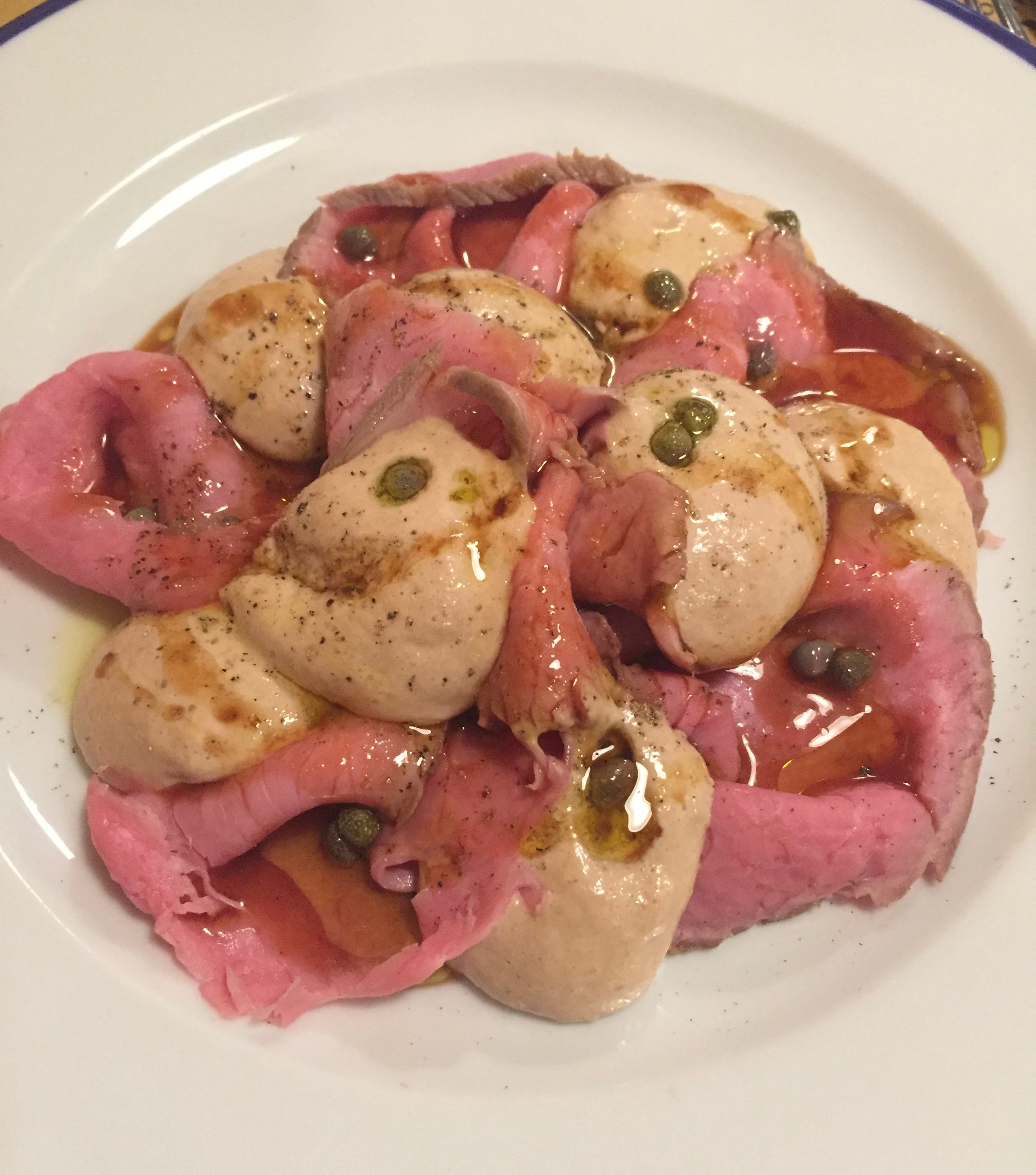
The first time I lived in Italy some 35 years ago, I lived in Turin, the capital of Piemonte. Like grissini (bread sticks), carne cruda (steak tartare), brasato al barolo (braised beef), and panna cotta (milk pudding), vitello tonnato was a regional specialty that remained more or less localized. Twenty-five years later, when I lived in Milan, vitello tonnato was experiencing a bit of a broader renaissance. Young chefs who trained in Michelin starred restaurants were opening more casual trattorie and experimenting with classic dishes. Although named for another signature, Diego Rossi’s wildly popular Trattoria Trippa served a vitello tonnato that’s become legendary.
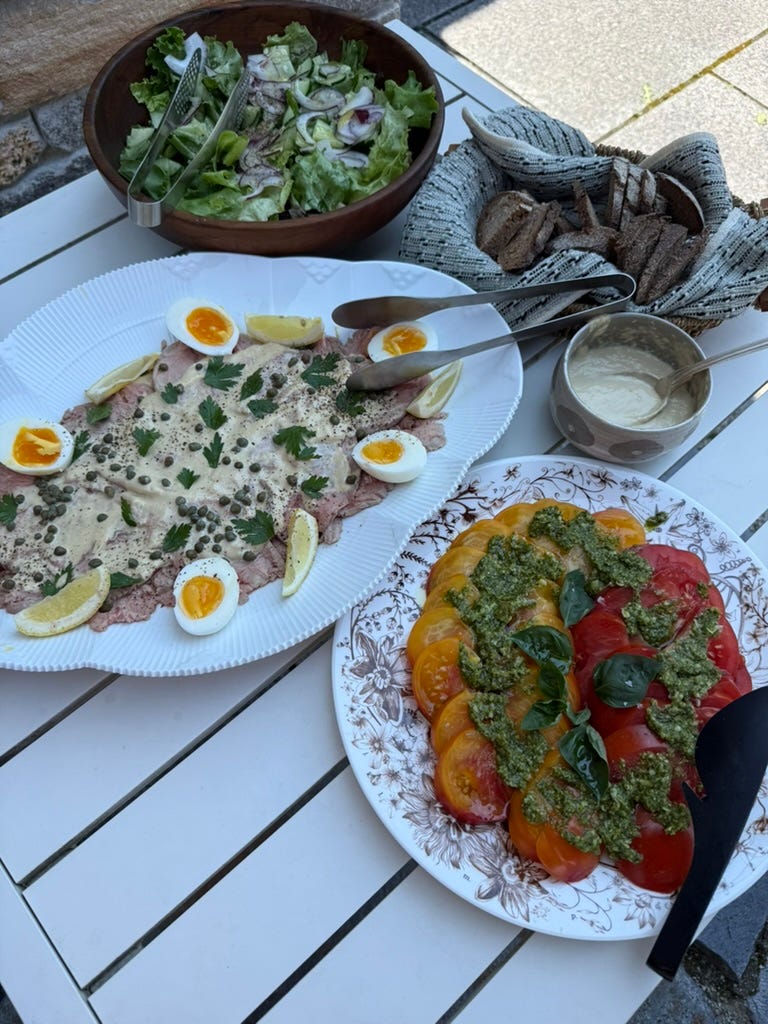
During the heat wave in New England this past weekend I served vitello tonnato for an al fresco lunch with friends. A couple of guests scratched their heads, while the others licked their plates clean. I would encourage you to give it a try.
A few tips…
You can cook the veal any way you choose—roasted, braiseed, poached, or as I did Friday, sous vide, which takes out all of the guess work, but requires an immersion circulator to hold a constant water temperature. The goal is to keep it moist, that is, not overcook it, though there should be enough tuna sauce to cover any errors. I give instructions for sous-vide and braising, below. I think a veal eye of round—a single, boneless muscle from the rear leg of the calf—is the ideal cut, as it is lean, compact, and slices well when chilled. Have the butcher tie it so it keeps its shape.
For best results, cook the veal a day or two in advance so it has time to properly chill before you slice it. I didn’t have that time this weekend, so once I removed my veal from my immersion circulator, I chilled it down quickly in an ice bath.
As for the tuna, because it plays a starring role, you’ll want to use a premium brand packed in extra-virgin olive oil, preferably one imported from Italy or Spain.
The rest of the ingredients—olive oil, capers, lemon juice, eggs, parsely—are staples you should always have on hand.
RECIPE: Vitello Tonnato
Serves 6 to 8
1 veal eye of round (1 3/4 to 2 pounds), tied
Salt and freshly ground black pepper
1 sprig fresh rosemary
2 or 3 sprigs fresh thyme
1 clove garlic
1 bay leaf
3/4 cup extra-virgin olive oil
1/2 medium onion (if braising)
1 carrot, peeled and diced (if braising)
1 stalk celery, peeled and diced (if braising)
3/4 cup white wine (if braising)
4 ounces albacore or other tuna, preserved under extra-virgin olive oil (keep the oil)
1 anchovy (optional, but encouraged)
1 egg yolk
Juice of 1 lemon
1 teaspoon Dijon mustard
Dash of Tabasco
3 tablespoons capers
Fresh parsley, jammy eggs, lemon wedges
To cook the veal sous-vide, place your immersion circulator in a vessel of warm water and set to 135°F. (57°C.). Season the veal generously with salt and black pepper. Place the veal into a vacuum bag or resealable plastic bag. Add the rosemary, thyme, garlic clove, bay leaf, and about a tablespoon of the olive oil to the bag. If using a vacuum sealer, seal the bag and submerge it in the hot water. If using a resealable bag, use the displacement method to close the bag while the veal is submerged in the hot water. Cook the veal for 2 1/2 hours. Remove from the water, cool to room temperature. Open the bag and save any cooking juices that have accumulated, discarding all the aromatics except for the garlic, which you can keep in the cooking juices.
For added flavor and visual appeal, if you like, you can sear the cooked veal. Pat dry. Heat some of the olive oil in a frying pan and sear the meat on all sides. Wrap the cooked veal in plastic and chill at least 12 hours.
Alternately, to braise the veal, in a small Dutch oven or other heavy pan with a tight-fitting lid, heat a couple of tablespoons of the olive oil over medium-high heat. Season the veal generously with salt and pepper and sear in the hot pan on all sides to brown. Remove the veal to a plate. Add the onion, carrot, celery, and a pinch of salt, to the pan, and sauté until soft, about 4 minutes. Add the veal back to the pan along with any of the juices that have accumulated on the plate. Add the rosemary, thyme, garlic, bay leaf, and white wine to the pan along with about 3/4 cup of water. Bring to a boil, reduce the heat to a simmer, cover, and cook gently for about 2 hours, until cooked through, about 140°F. on an instant-read thermometer. Cool to room temperature in the braising liquid. Wrap the veal in plastic and chill for at least 12 hours. Remove the garlic clove and reserve, strain the braising liquid and reserve with the garlic in the refrigerator until needed.
To prepare the tuna sauce the next day (or once the veal has chilled), in a food processor fitted with a metal chopping blade or the jar of a blender, combine the tuna, along with the oil it is packed in, the anchovy, if using, egg yolk, lemon juice, and Dijon. Add 2 tablespoons of the cooking juices from the veal—which may have gelled when chilled—and the cooked garlic clove. Pulse and then blend to a smooth paste. With the machine running, slowly drizzle in the remaining olive oil to form a thick mayonnaise-liks emulsion. Add a tablespoon of the capers and a dash of Tabasco. Season with salt and black pepper and blend until smooth. Taste and adjust the acidity and seasoning to taste.
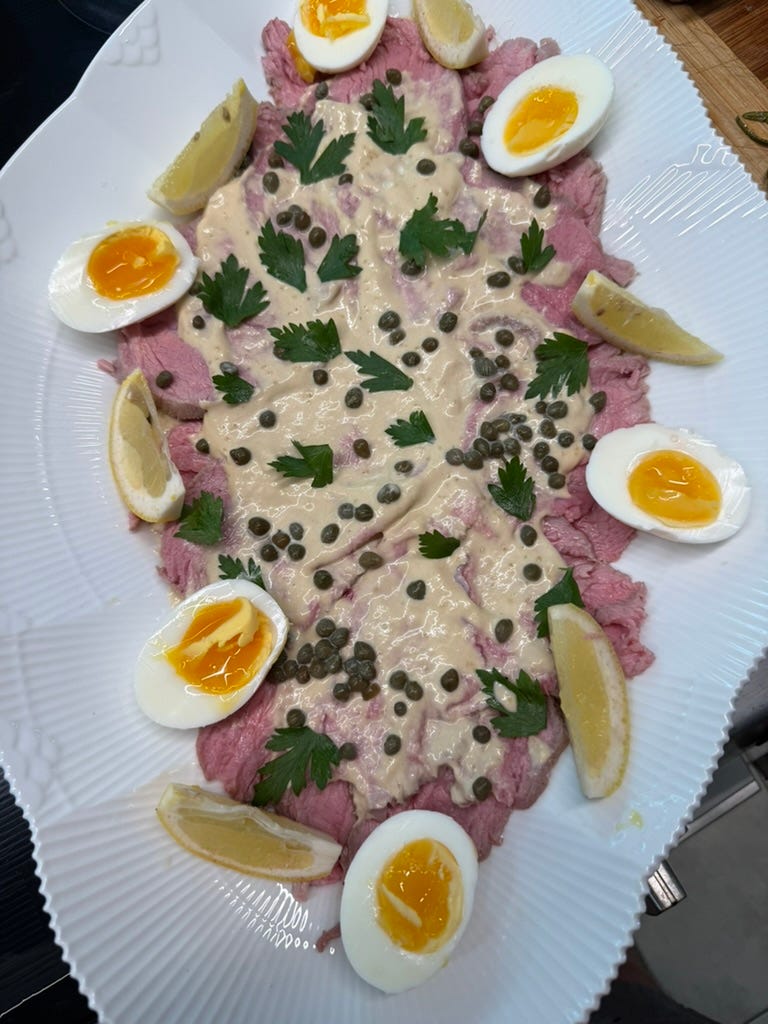
To serve, slice the chilled veal very thinly across the grain. Spoon some of the tuna sauce onto a serving platter and spread to make a thin layer. Arrange a layer of the veal on top and spoon and spread more sauce on the veal. Scatter 1 tablespoon of the capers and some fresh parsley leaves on the sauce. Grind on some black pepper, and repeat the layering of veal, tuna sauce, capers, parsley, and black pepper. Garnish with jammy-cooked eggs, parsley, and lemon wedges to serve.
Four Favorites in Milan
After living in Milan for almost a year in 2015, I developed a deep love for the city. Until then, like most tourists to Italy, all I had ever seen was the Malpensa airport. People love to hate Milan. Her charms may be quiet, but they are many. I’ve been back almost every year since, except when we couldn’t travel due to COVID. Watching the XXV Winter Olympics earlier this year and then The Devil Wears Prada 2—in both of which Milan plays a starring role—I’ve been yearning to return.
Though the city is chock full of Michelin stars, I prefer to hang out in the more casual trattorie and osterie, where stylish Milanese dressed for the runway eat simpler food with gusto. For paid subscribers, I offer a cheat sheet of four of my Milanese musts for traditional dishes…
